
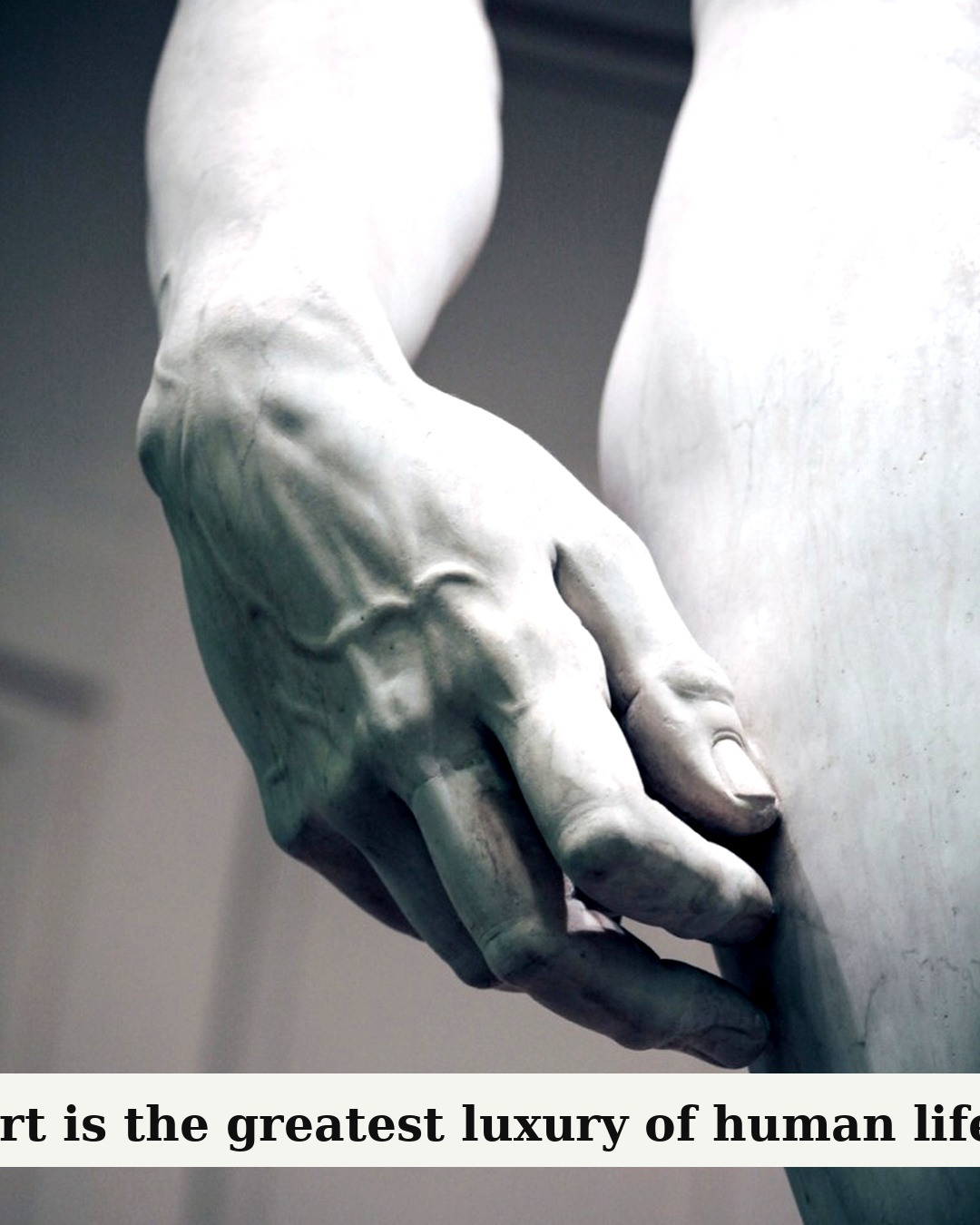
Divino’s Genius Made Flesh in Marble
The giant of the Renaissance, the breaking point of art history. A man with a hammer in one hand and a rebellious soul in the other, shaping marble. His David is not merely a sculpture; it is the manifesto of freedom in Western art.
I. THE BIRTH OF GENIUS: Far More Than an Artist
Florence, March 6, 1475. The son of a stonecutter, Michelangelo di Lodovico Buonarroti Simoni did not yet know that he would carve his name into the highest summit of art history. When he entered Domenico Ghirlandaio’s workshop at thirteen, his sketches astonished even his master. But the true turning point came when he entered the patronage of the Medici family. The young Michelangelo, raised among ancient sculptures in Lorenzo de’ Medici’s gardens, internalized the spirit of classical art so deeply that he would soon leave the old masters behind.
What Set His Art Apart from His Contemporaries
What distinguished Michelangelo from his contemporaries was a radical transformation in his approach to art. While the great masters of his time—Leonardo, Raphael, Botticelli—focused on the aesthetic beauty of painting and sculpture, Michelangelo’s concern was something else entirely: to discover the divine within the human body.
At the center of his art lies terribilità—literally “terribleness” or “majestic awe.” This concept defines that imposing, almost threatening power inherent in Michelangelo’s figures. While Leonardo’s figures dissolve into nature, while Raphael’s angels glide gracefully, Michelangelo’s humans carry the weight of existence itself.
Another defining difference was Michelangelo’s conviction that sculpture stood above all other art forms. “Every good sculptor,” he would say, “liberates the form that already exists within the marble by removing the excess.” This Platonic understanding—that form already resides within the stone and the artist’s task is merely to bring it “to light”—entirely determined his working method. In contrast to Leonardo’s scientific observation or Raphael’s pursuit of harmony, Michelangelo immersed himself in marble with something approaching religious devotion.
II. THE SOUL TAKING FORM IN MARBLE: The Anatomy of Sculpture
The most defining characteristic that sets Michelangelo’s sculptures apart from all others is his treatment of human anatomy as a reflection of the soul. In his hands, muscles, tendons, veins are not merely biological structures; they are expressions of rage, of pain, of hope, of divine ecstasy.
1. Anatomical Perfectionism
Michelangelo learned human anatomy by secretly dissecting cadavers in Florentine hospitals—a pursuit not well regarded in his time. But this knowledge gave him the ability to render muscular structures with such realistic and dramatic precision that his sculptures appear to have hearts beating beneath their skin.
2. The Apex of Contrapposto
Though he inherited the classical technique of contrapposto (weight concentrated on one leg) from ancient Greek sculpture, Michelangelo advanced it so radically that his figures appear independent of their pedestals, rotating on their own axes, nearly moving.
3. The Aesthetics of the Unfinished (Non-finito)
The “unfinished” figures visible in many of Michelangelo’s sculptures represent a conscious aesthetic choice. In the non-finito technique, figures appear trapped within the marble block, struggling to “free” themselves while remaining partially embedded in raw stone. This revolutionary approach reveals the creative process itself, making visible the dramatic struggle between the artist’s hand and the marble.
4. Psychological Depth
Before Michelangelo, facial expressions in sculpture were typically idealized, cleansed of emotion. His figures, by contrast, are thinking humans. Their brows are furrowed, lips tight, gazes fixed on a distant point. Each sculpture carries an internal narrative; each muscle tension expresses an emotion.
III. DAVID: The Soul of a Republic, The Manifesto of an Artist
In 1501, a twenty-six-year-old artist received a commission: they sought a sculptor capable of working a massive marble block that had lain unused for half a century in Florence Cathedral’s workshop—a block previously attempted and abandoned by two masters, deemed flawed, left to weather in a Florentine courtyard for years. Michelangelo saw David within that stone.
How It Differs from Other Davids
Before Michelangelo, there were Donatello’s David and Verrocchio’s David. But these predecessors depicted the moment of victory: David, having beheaded Goliath, portrayed as a young conqueror with the giant’s head beneath his foot.
Michelangelo chose a completely different moment: the instant just before the struggle.
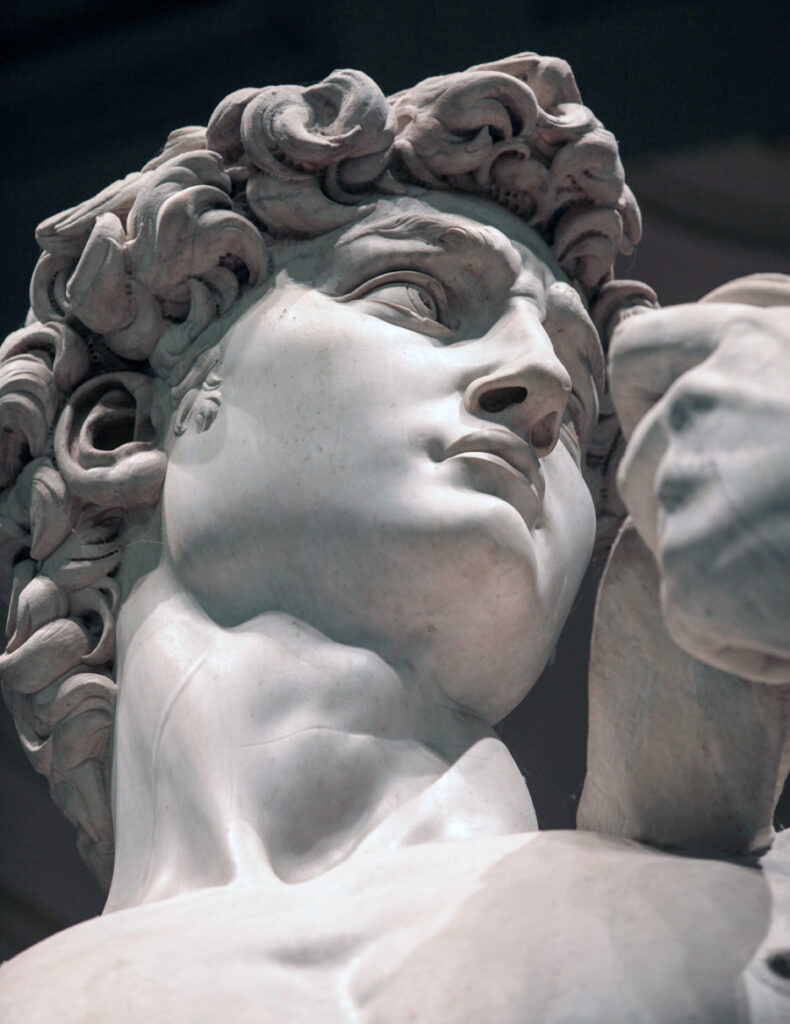
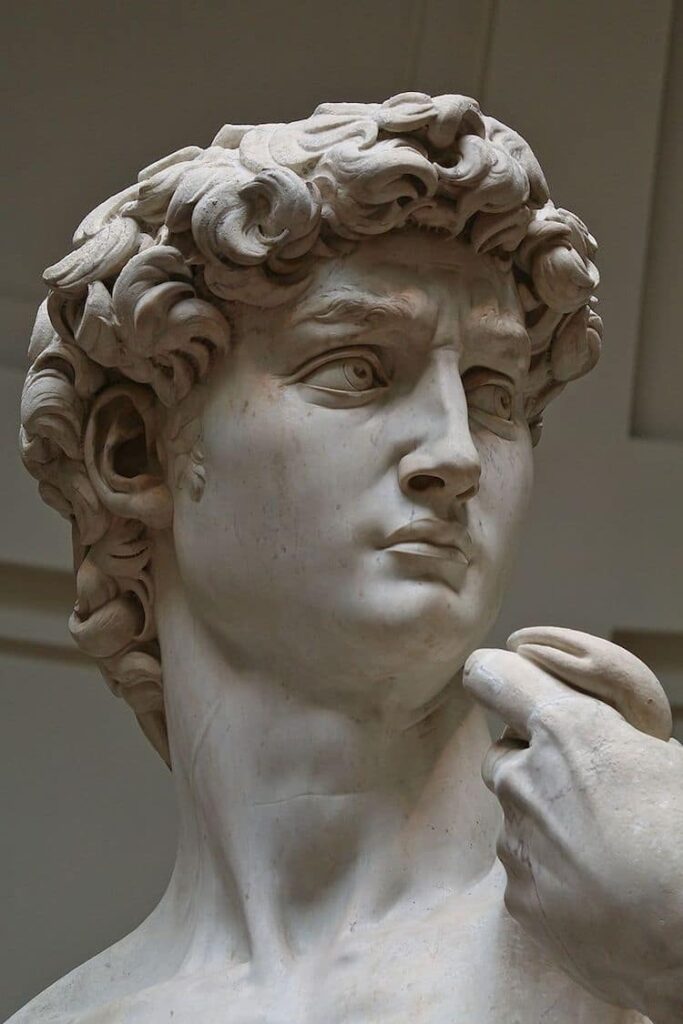
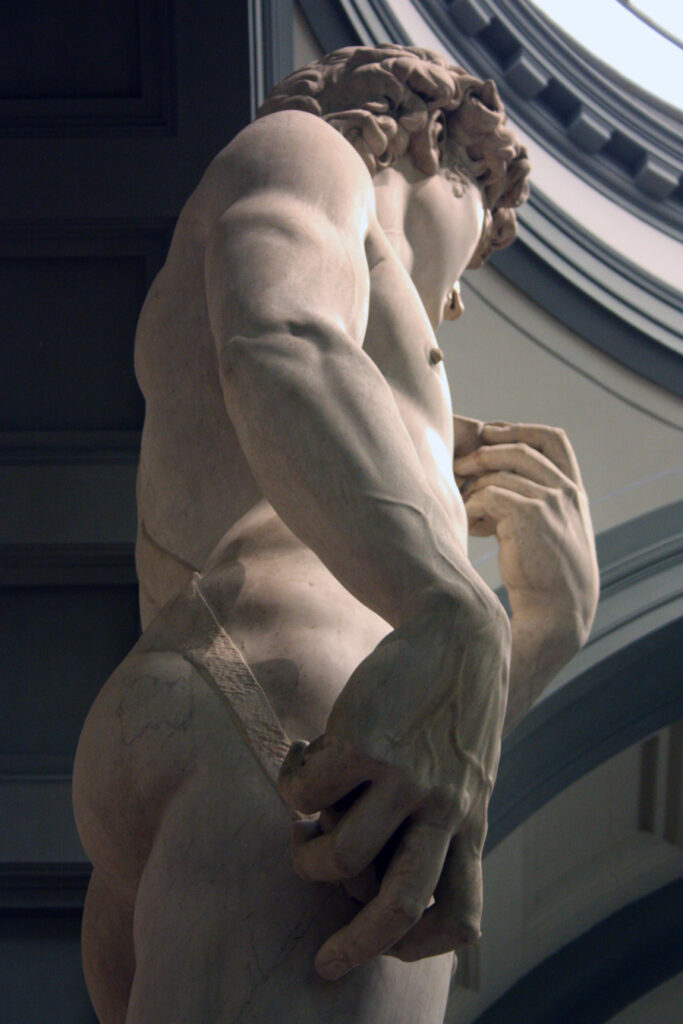
We see David not after battle, but immediately before engaging. Every muscle in his body is tensed. His right hand holds the sling, resting over his left shoulder. His left hand holds the stone he will soon use. His gaze weighs the giant before him. His brow is furrowed, nostrils flared. This is not a shepherd boy; this is a thinker, a warrior in the moment before action.
What Sets This Sculpture Apart
1. Scale and Monumentality
At 5.17 meters in height, David was the largest sculpture created in the Renaissance up to that time. This colossal scale transformed David from a mere religious figure into a civil symbol for the Florentine Republic. When completed, the decision was made not to place it in the cathedral; instead, Florentines installed this giant in the heart of their city, before Palazzo Vecchio. David represented small Florence defying the great powers that threatened it—the Medici, the Pope, Milan, Naples.
2. Anatomical Exaggeration
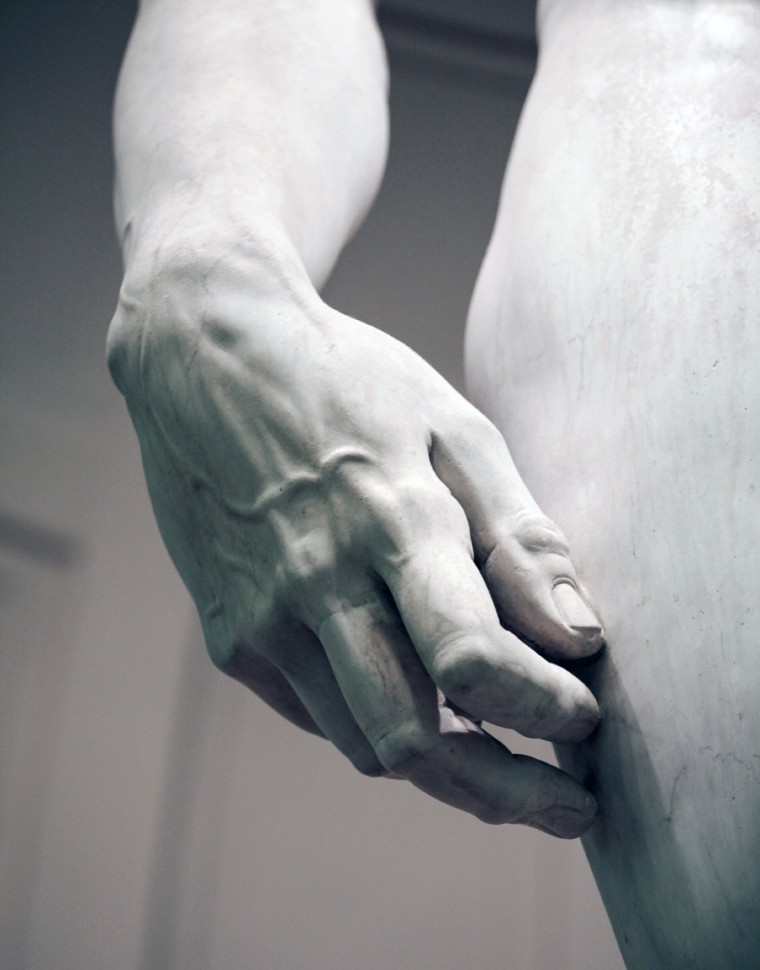
Michelangelo intentionally made David’s hands and head proportionally larger than his body. This was originally intended to compensate for the sculpture’s planned elevation, where viewers would look up at it from below. But this disproportion also symbolizes power: these are the hands that will slay the giant; this is the head that conceives the strategy.
3. The Direction of the Gaze
David’s eyes are fixed toward Rome. This is a challenge aimed directly at the Florentine Republic’s greatest adversary. In the facial expression, Michelangelo entirely abandoned classical idealism. David’s face, like Michelangelo’s own soul, is tense, defiant, questioning.
4. The Perfect Flaw
The marble block was known to be flawed. Masters had considered it too thin in certain sections, fearing breakage. Michelangelo turned this flaw into an advantage. The slender connection between David’s left leg and torso stands as a manifesto of courage: the artist, pushing the limits of his material, achieved the impossible.
IV. COMPLETE WORKS: From Marble to Fresco, The Record of an Era
Michelangelo’s 89-year lifetime produced one of the most prolific bodies of work in art history. Here are his principal works:
Sculptures
| Title | Year | Location | Brief Detail |
|---|---|---|---|
| Pietà | 1498-1499 | St. Peter’s Basilica, Vatican | Created at twenty-three. Depicts the Virgin holding the dead Christ. Mary’s youthful appearance is interpreted as “the immortal purity of the virgin.” The only work Michelangelo signed—across Mary’s chest. |
| David | 1501-1504 | Galleria dell’Accademia, Florence | The pinnacle of Renaissance sculpture. Carved from a single marble block, standing 5.17 meters tall. |
| Moses | 1513-1515 | San Pietro in Vincoli, Rome | Created for Pope Julius II’s tomb. Moses is depicted with horns (from a translation error in iconography), rising in fury. The muscle tension beneath his right arm remains one of sculpture’s most powerful anatomical details. |
| Dying Slave | 1513-1516 | Louvre Museum, Paris | One of the most striking examples of non-finito. The figure, trapped within raw stone, appears to struggle toward liberation. |
| Rebellious Slave | 1513-1516 | Louvre Museum, Paris | In contrast to the Dying Slave, this figure surrenders to the peace of death. Both slave sculptures were parts of the unfinished Julius II tomb project. |
| Bandini Pietà | 1547-1555 | Museo dell’Opera del Duomo, Florence | Among Michelangelo’s late masterpieces. The most extreme example of non-finito. The figures of Mary, Christ, and Mary Magdalene nearly dissolve into a single mass. |
| Rondanini Pietà | 1552-1564 | Castello Sforzesco, Milan | The final sculpture, worked on until days before his death. Figures become completely abstracted, thinned, stripped of earthly weight. |
Paintings
| Title | Year | Location | Brief Detail |
|---|---|---|---|
| Sistine Chapel Ceiling | 1508-1512 | Vatican | Four years of work, painting standing (contrary to the myth of lying on his back). This immense fresco cycle narrates human history from Creation to the Flood. The Creation of Adam scene, with fingers nearly touching, remains one of art history’s most iconic moments. |
| The Last Judgment | 1536-1541 | Sistine Chapel, Vatican | Created a quarter-century after the ceiling fresco on the chapel’s altar wall. Depicts the Second Coming. The nudity of the figures was covered after Michelangelo’s death in the “fig leaf campaign.” |
Architectural Works
| Title | Year | Location | Brief Detail |
|---|---|---|---|
| Laurentian Library | 1524-1534 | Florence | Among the first examples of Mannerist architecture. The staircase design deliberately subverts conventional architectural rules. |
| Piazza del Campidoglio | 1536-1546 | Rome | The masterpiece of Renaissance urban design—a trapezoidal square at the heart of ancient Rome. |
| St. Peter’s Basilica Dome | 1546-1564 | Vatican | Completed based on Bramante’s original plans. The dome now defines Rome’s silhouette. When Michelangelo died, the drum of the dome was completed. |
V. UNREALIZED WORKS: Projects That Remained Sketches
Michelangelo’s greatest tragedy was the Tomb of Pope Julius II—a project to which he dedicated nearly twenty years of his life, yet was never completed. Originally conceived in 1505 as a monumental structure with forty sculptures, the tomb was continually postponed, reduced in scale, and ultimately completed in a form far removed from Michelangelo’s plans. Hundreds of sketches from this project survive—the Moses, the Dying and Rebellious Slaves are remnants of this unfinished vision.
The sculptural cycle planned for the Medici Chapel in Florence also remained incomplete. Though Dawn and Dusk were finished, the figures of Day and Night were left in non-finito.
Additionally, hundreds of drawings by Michelangelo survive to this day. Preserved in the British Museum, the Louvre, and Casa Buonarroti, these include:
- Workshop studies for battle scenes (sketches for the Battle of Cascina)
- Hundreds of figure studies for The Last Judgment
- Technical drawings for architectural projects
- Notebooks containing his poetry
- Stylized studies from his early years in Ghirlandaio’s workshop
VI. THE ARTIST AND HIS PERSONALITY: The Psychology of Creation
To understand Michelangelo’s art, one must understand his personality. He was, as his contemporaries described him, a terribile man—difficult, touchy, irascible, incapable of getting along with anyone. He had an open rivalry with Leonardo, openly envied Raphael, constantly fought with his patrons. Pope Julius II had him driven from the Vatican; during the siege of Florence, he was forced to flee the city after corresponding with enemy camps.
The impact of this personality on his work was immense.
1. Solitude and Production
Michelangelo never married. Apart from his close friend, the poet Vittoria Colonna, there are few known deep emotional connections. This solitude confined him to his workshop. He spent days, weeks, months before a single marble block. This withdrawal afforded him a focus unlike most artists of his time.
2. Platonic Love and the Body
As Michelangelo’s poetry reveals, his admiration for bodily beauty fused with Platonic love. For him, the human body was the earthly reflection of the divine. Thus his figures, unlike those of his contemporaries, are not merely aesthetic objects but dwellings of the soul.
3. Melancholy and Obsession with Death
Themes of death increasingly dominate Michelangelo’s late works. The Rondanini Pietà, with its nearly abstract figures stripped of all earthly substance, stands among the most poignant expressions of an artist confronting his own mortality. “My soul awaits liberation from the prison of the body to reach God,” he wrote in one sonnet.
4. Struggle with Marble
Michelangelo viewed marble as an adversary. He called it “the resistant material.” The dramatic tension in his sculptures represents the visible trace of his struggle with the stone. Each muscle tension, each gaze, emerges victorious from this battle.
VII. CONCLUSION: The Legacy of Il Divino
When Michelangelo died in Rome on February 18, 1564, at the age of 89, he left behind the greatest body of work in art history. His nephew, fearing for his legacy, burned some of his drawings—but what remains still exceeds what any single human life could reasonably produce.
His David still stands in the heart of Florence, reminding all who see it of what a human being can achieve. The Sistine ceiling still shows how solitude can build a cathedral. St. Peter’s dome still reads as an architect’s signature written against the sky.
What made Michelangelo great was not merely his technical perfection. What made him great was his transgression of limits. His own limits. His material’s limits. Art’s limits. And in every moment of this transgression, he succeeded in bringing forth the soul hidden within the stone.
Il Divino—the Divine One. His contemporaries gave him this name because everything that came from his hand contained something beyond the human. Genius made flesh in marble. A soul carved into eternity.
“Every block of stone has a statue inside it; it is the task of the sculptor to discover it.”
— Michelangelo Buonarroti
Michelangelo’s David and His Eternal Genius
An Editorial Exploration
Michelangelo Buonarroti, born in 1475 in Caprese and died in 1564 in Rome, was not merely an artist — he was a visionary who pushed the boundaries of the human spirit. No other figure in art history has captured both physical and spiritual tension with such raw power and intensity as Michelangelo did. While Leonardo da Vinci embodied scientific curiosity and Raphael represented harmony and grace, Michelangelo’s work was defined by struggle, torment, and divine spark.
How Michelangelo’s Art Differed from His Contemporaries
Michelangelo viewed sculpture as an act of liberation. He famously said that he did not create figures, but rather freed them from the marble. Unlike Donatello’s youthful, delicate, and victorious David, Michelangelo’s David is a titan on the verge of battle — tense, determined, and not yet victorious. This focus on potential energy, inner conflict, and the divine power of human will became the defining characteristic of his art.
Michelangelo’s Major Sculptural Works
Key Sculptures and Works (with brief details):
- Pietà (1498–1499, Vatican) Created when Michelangelo was only 23, this is his first undisputed masterpiece. The serene sorrow of Mary holding the lifeless Christ remains one of the most moving expressions of grief in Western art.
- David (1501–1504, Florence) The central focus of this article. Standing 5.17 meters tall, it is the most magnificent human figure ever carved from marble.
- Moses (1513–1515, San Pietro in Vincoli) Part of the unfinished Julius II tomb. The fury in his eyes and the dynamic flow of his beard demonstrate how Michelangelo could bring stone to life.
- Dying Slave & Rebellious Slave (1513–1516) Housed in the Louvre. These two works powerfully depict the human body’s struggle between captivity and the desire for freedom.
- Victory (1532–1534) An unfinished work for the Medici Chapel, showing a young man triumphing over an older figure.
- Rondanini Pietà (1552–1564) Michelangelo’s final and most haunting work. Left unfinished at his death, the figures almost dissolve into one another — a powerful precursor to modern abstraction.
Unfinished or Planned Projects
Michelangelo left many works incomplete, believing that a sculpture was never truly “finished” until the artist’s death. Major unfinished projects include:
- Tomb of Pope Julius II (commissioned 1505) – Originally planned with 40 sculptures.
- Façade of San Lorenzo Church (1516–1520)
- Hercules and Cacus (a colossal sculpture planned after David)
- Numerous sketches for the Neptune Fountain
What Made His David Unique Among All Other Davids?
While Donatello and Verrocchio portrayed David after his victory — calm and graceful — Michelangelo showed him before the battle. His David is not celebrating; he is preparing. The intense gaze, furrowed brow, and tensed muscles convey a psychological depth never before seen in sculpture. Technically, Michelangelo’s mastery of marble anatomy — the visible veins, the subtle shift of weight, and the sense of living flesh beneath stone — remains unmatched.
Michelangelo’s Personality and Its Impact on His Art
Michelangelo was solitary, irritable, fiercely independent, and a perfectionist. He argued with popes, rejected commissions, and often abandoned projects. Yet this difficult temperament fueled his genius. He saw creation as a form of suffering and struggle. This inner conflict gave his works an extraordinary spiritual intensity that continues to move viewers more than five centuries later.
In Conclusion
Michelangelo did not simply sculpt the human body — he revealed the divine potential and torment within it. His David stands not only as a symbol of Florentine pride, but as the ultimate representation of human will, readiness, and greatness. He remains one of the rare artists who did not imitate nature, but rather competed with it — and, in many ways, surpassed it.