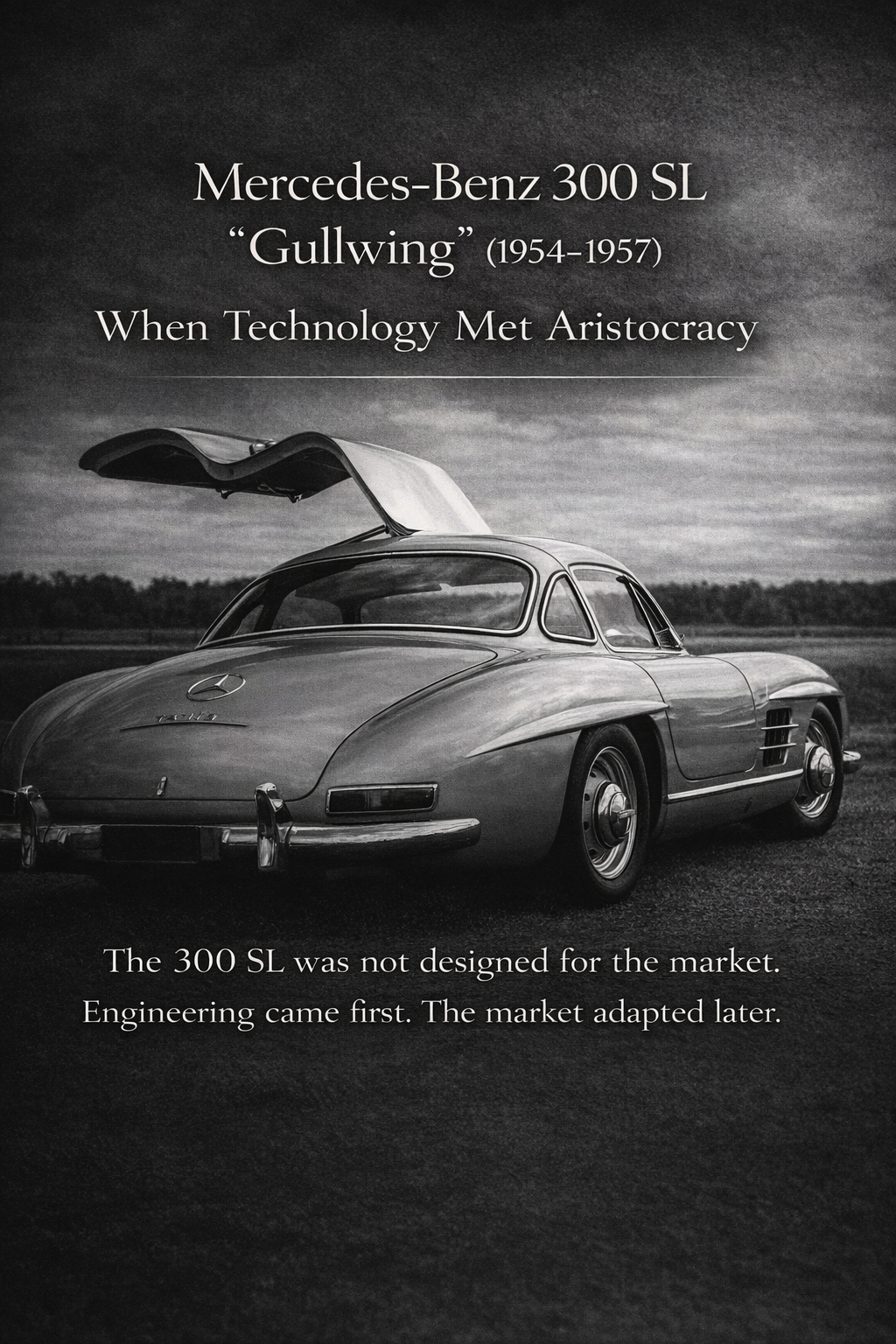
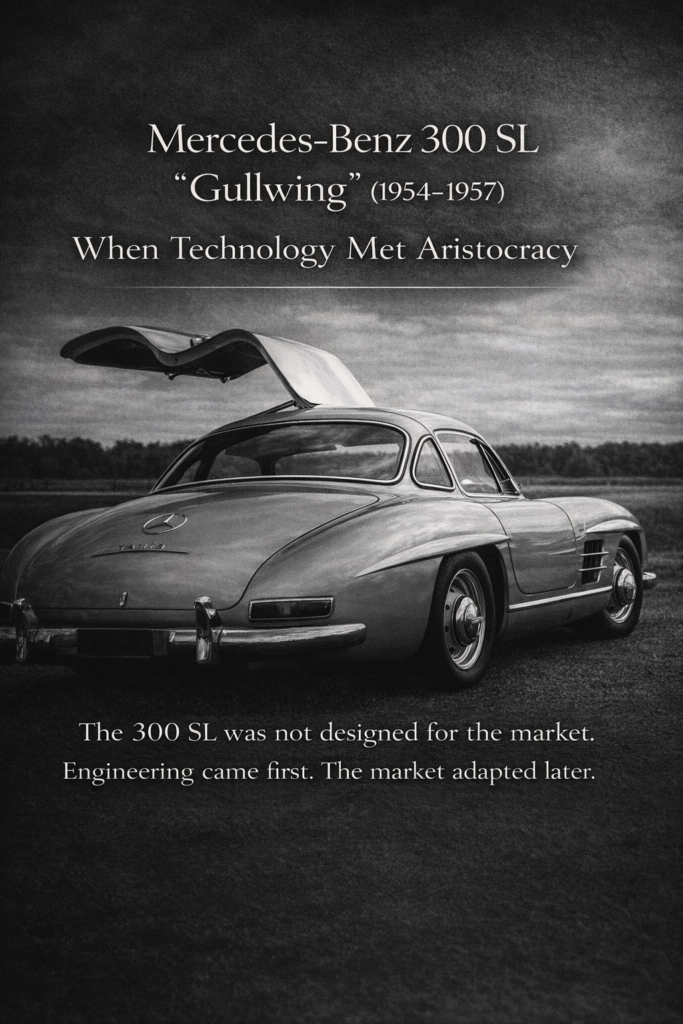
Mercedes-Benz 300 SL Gullwing (W198)
The Engineering Manifesto That Defined Automotive Permanence)
For the true connoisseur, genius is rarely found in what is added, but in what is For the true connoisseur, genius is rarely found in what is added, but in what is revealed through absolute constraint. The Mercedes-Benz 300 SL Gullwing is not merely an automobile; it is automotive philosophy rendered in aluminium and steel — a living testament that necessity remains the mother of iconic design.-Benz 300 SL Gullwing (W198) A Masterclass in Forced Elegance: The Engineering Manifesto That Redefined Automotive Aristocracy
I. Genesis: I. Genesis: From Victory Podium to Icon Victory Podium to Icon
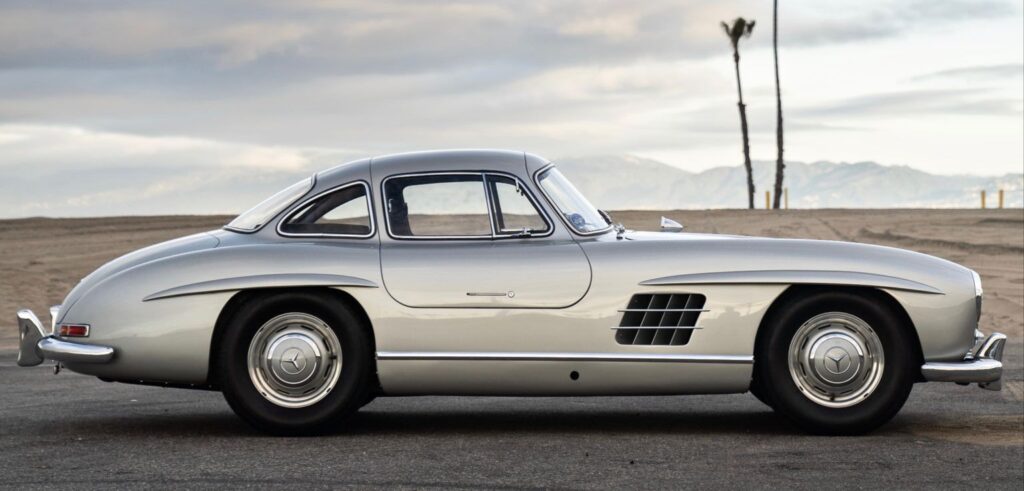
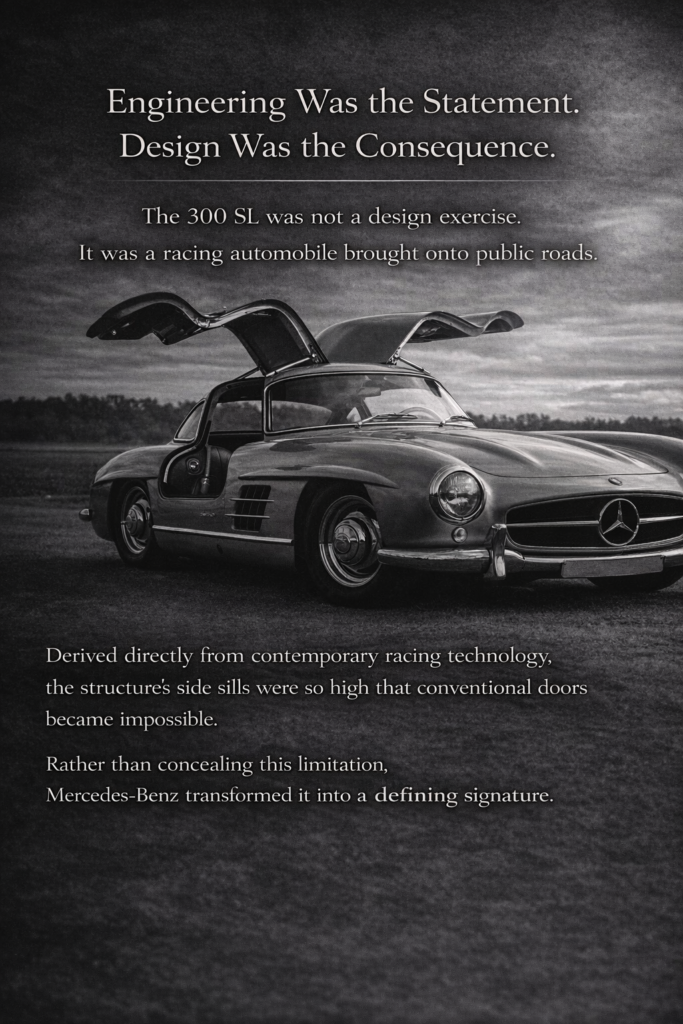
The Gullwing’s story did not begin on a designer’s drawing board, but on the winner’s podium at Le Mans and the Carrera Panamericana in 1952. When Mercedes decided to translate the raw, competition-proven performance of the W194 racer to the road, its engineers faced a fundamental dilemma. The revolutionary spaceframe chassis — the “Rohrrahmen” — featured side sills so high that conventional doors were structurally impossible.
A lesser marque would have compromised the chassis. Mercedes chose instead to weaponise the constraint. Thus were born the iconic upward-swinging “Gullwing” doors — not as a stylistic flourish, but as the only elegant engineering solution to a pure technical equation. They remain the car’s most famous feature precisely because they were never intended as a feature at all; they are the chassis made visible.the true connoisseur, genius is rarely found in what is added, but in what is A Masterclass in Forced Elegance: The Engineering Manifesto That Redefined Automotive Aristocracy


II. The Spaceframe Revolution: 25 Kilograms of Philosophy
At the heart of the Gullwing lies its revolutionary tubular spaceframe chassis, weighing a mere 25 kg. While contemporaries such as the Jaguar XK120, Aston Martin DB2/4 and Chevrolet Corvette C1 still relied on heavy ladder-type or platform frames, Mercedes created a three-dimensional lattice of thin steel tubes offering extraordinary torsional rigidity and minimal weight.
The result was exceptional structural integrity combined with low mass. The body, hand-formed from aluminium panels for the bonnet, doors and boot lid, brought the dry weight down to just 1,295 kg — space-age technology for the mid-1950s.
III. The Injection Revolution: Bosch Brings Aviation to the Road
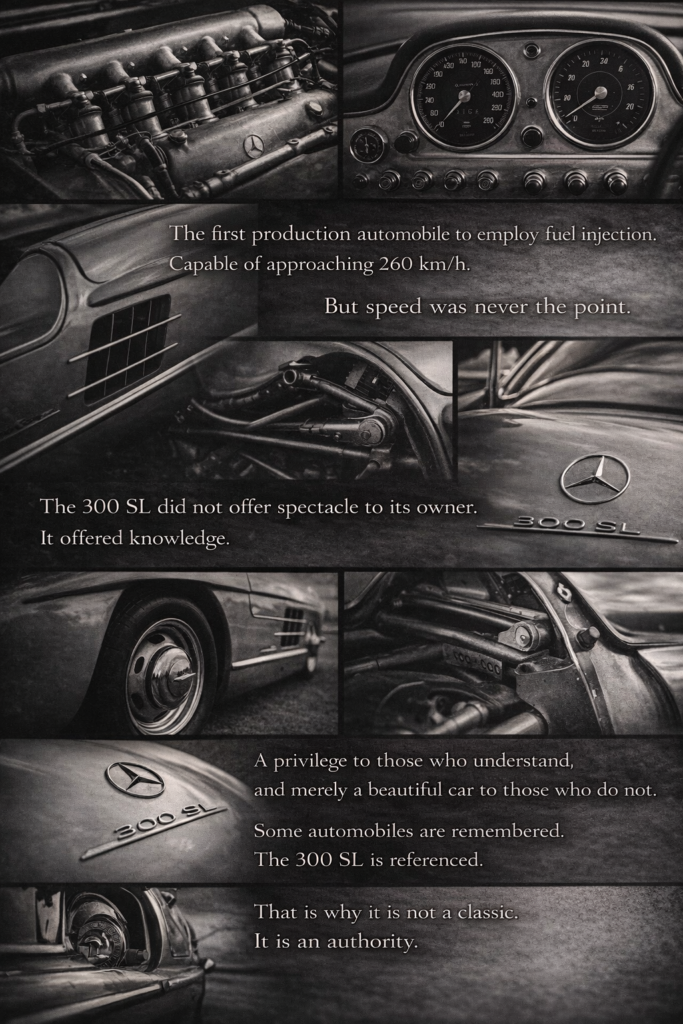
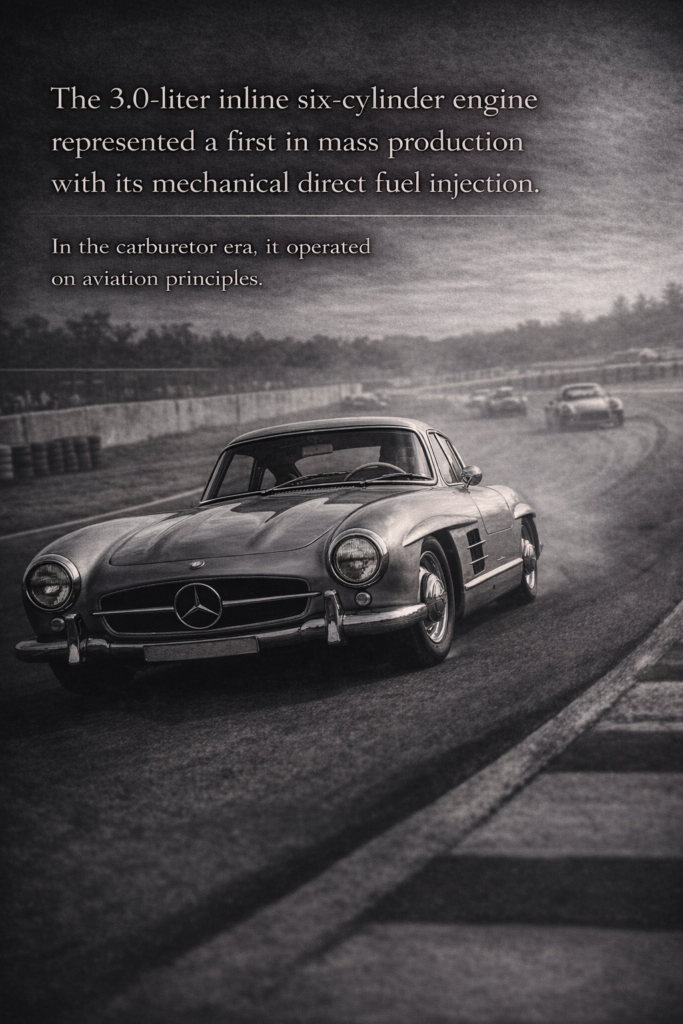
The Gullwing was the world’s first series-production petrol automobile equipped with mechanical direct fuel injection. The M198 3.0-litre inline-six engine delivered fuel at 75 bar directly into the combustion chambers via a Bosch six-plunger pump.
So advanced was the system that it required a dedicated alcohol reservoir to prevent fuel-line freezing in cold conditions. The result: 215 hp (DIN) — approximately 50% more power than a carburetted version — with a top speed approaching 250 km/h and 0-100 km/h in approximately 8.8 seconds.


IV. Dynamic Mastery: Beyond Straight-Line Speed
* Fully independent swing-axle rear suspension with negative camber geometry delivered handling poise unknown to the live-axle cars of the era.
* Large Alfin drum brakes provided impressive stopping power.
* Functional aerodynamics achieved a drag coefficient of Cd 0.25 — exceptional for 1954.
The Gullwing was not merely fast; it was controllably, predictably fast.
V. Production Reality: Hand-Built Rarity
Between 1954 and 1957, only 1,400 Gullwing Coupés were produced. Of these, just 29 were built entirely in aluminium — the most coveted examples today. The majority were exported to the United States.
Every car was hand-assembled in Sindelfingen with meticulous craftsmanship.
For context:
* Ferrari 250 GT series: approximately 900–1,000 units
* Jaguar XK120: over 12,000 units
* Aston Martin DB2/4: around 700 units
The Gullwing achieved rarity not merely through limited numbers, but through unmatched intellectual and engineering density.
VI. Technical and Philosophical Differentiation from Contemporaries
Jaguar XK120: Beautiful and fast, yet carburetted, live-axle and heavier — a romantic British roadster.
Ferrari 250 GT: Emotional V12 and sculptural coachwork, but lacking the Gullwing’s structural rigidity and injection precision.
Aston Martin DB2/4: Elegant and balanced, yet far less radical.
Corvette C1: Powerful V8, but compromised by fibreglass body and primitive chassis — pure American muscle, not engineering sophistication.
The Gullwing stood alone: perfection born of necessity. Form was forced to follow function — and the result became legend.
VII. Collector Value and Enduring Legacy
Today, pristine matching-numbers Gullwings routinely command between 1.5 and 3 million USD. Fully aluminium-bodied examples have achieved 5 to 9 million USD at auction.
Its value is anchored not only in scarcity but in its position as a definitive chapter in automotive intellectual history. Originality remains paramount; restored examples trade at a significant discount to original-paint, matching-numbers cars.
The 300 SL Gullwing is the purest expression of Mercedes’ long-standing philosophy that “engineering comes first.”
It is not a car.
It is the triumph of necessity.
The Origin of Authority
Engineering before market

In the early 1950s, the automotive world was still shaped by comfort, chrome, and displacement. Mercedes-Benz asked a different question:

“How much of a racing car can remain intact on the road?”

The answer emerged in 1954:
the Mercedes-Benz 300 SL Gullwing.

This was not a design exercise. It was an engineering translation—derived directly from the W194 race car that dominated Le Mans and the Carrera Panamericana in 1952.

II — Spaceframe Architecture: A Structural Revolution
Lightness as engineering intelligence

At the core of the 300 SL lies the tubular spaceframe chassis (Rohrrahmen)—a radical departure from conventional construction:

Weight: approximately 25 kg
Exceptional torsional rigidity
Racing-grade structural integrity

Compared to the ladder-frame architectures of its contemporaries, it was:

Lighter
Stronger
Fundamentally more advanced

Yet this architecture created a constraint:


The solution?

Gullwing doors

Not a stylistic flourish,
but the visible consequence of structural truth.

Technical Specifications: A Generation Ahead
Precision over power
Engine: M198 Inline-Six
2,996 cc
~215 hp @ 5,800 rpm
274 Nm torque
0–100 km/h: ~8.8 seconds
Top speed: ~250 km/h

These figures are impressive.
But they are not the point.

Direct Fuel Injection (Bosch)

The 300 SL became:

 the first production car with mechanical direct fuel injection

75 bar injection pressure
Fuel delivered directly into the combustion chamber
Up to 50% efficiency gain over carbureted systems

This was aviation logic applied to the road—
a decisive break from the carburetor era.

IV — Chassis Dynamics & Driving Philosophy
Control defines speed

The 300 SL was not merely fast.
It was composed.

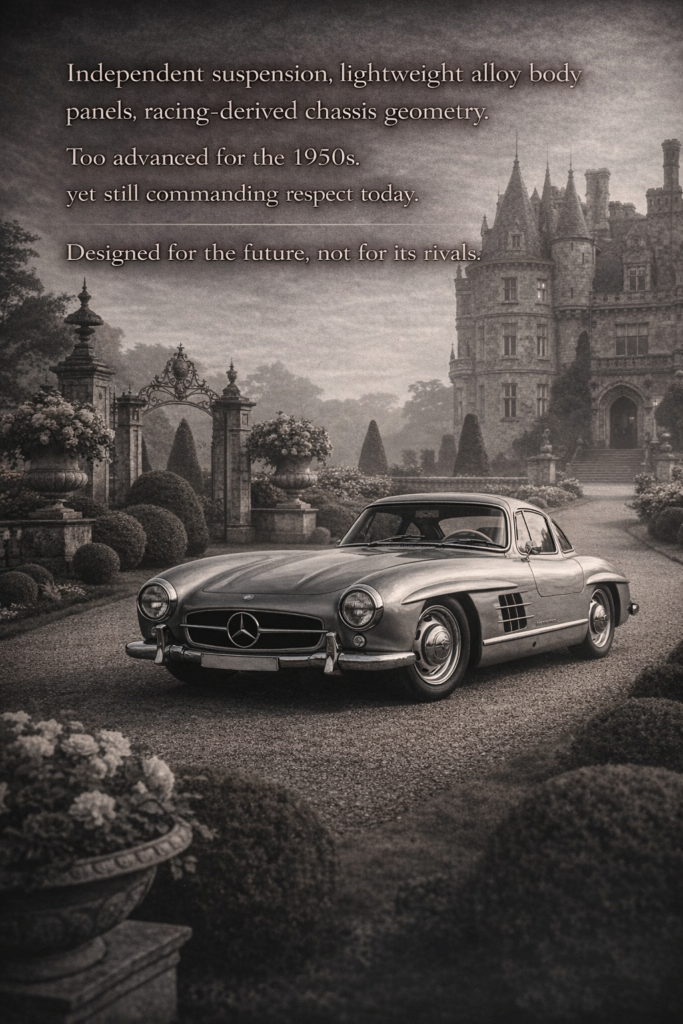
Fully independent swing-axle suspension
Precise steering geometry
Large drum brakes
Aerodynamically refined body (Cd ~0.25–0.38)

Where many contemporaries pursued straight-line speed,
the Gullwing engineered balance.

Materials & Construction
Material is a statement of intent

The body construction reflects disciplined engineering:

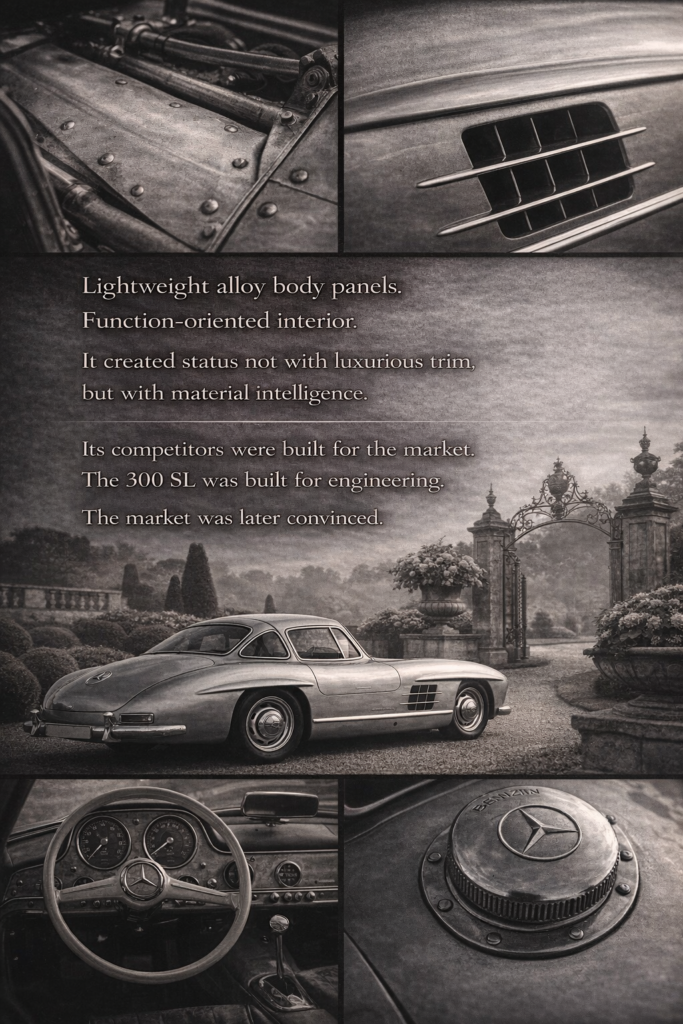
Steel primary structure
Hand-formed aluminum panels
bonnet
doors
boot lid

This combination achieved:

Weight optimization
Structural integrity
Performance efficiency

The interior follows the same philosophy:

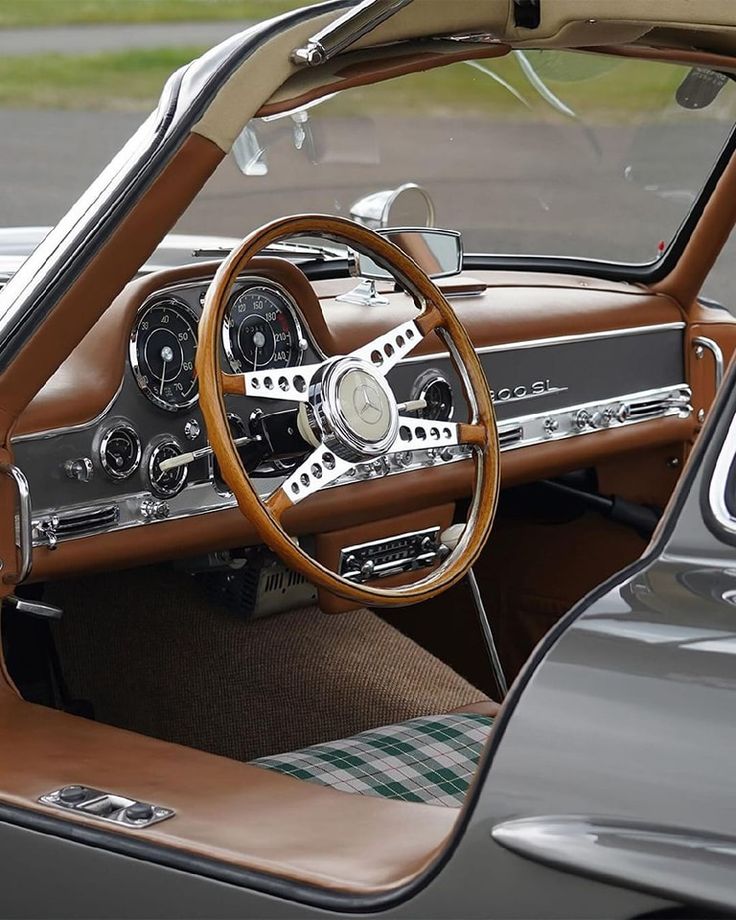
Minimalist cockpit
Driver-focused instrumentation
Functional luxury

Here, luxury is not displayed.
It is understood.

VI — Comparison: Why It Had No True Rival
Others followed markets. It defined direction.

In the 1950s, automotive philosophies diverged:

Ferrari
Engine-centric passion
High-revving emotional delivery
Jaguar
Elegant design
Conventional engineering
American cars
Large displacement
Visual dominance
The 300 SL did something else:

 It rejected all three

It was not market-led
It was not style-led
It was not emotion-led
It was problem-solving led


Production & Rarity
Scarcity as consequence, not intention
Production: 1954–1957
Total: ~1,400 Coupés

This number was not strategic limitation.
It was the natural outcome of:

engineering complexity
production discipline

Each car represents:

 a hand-finished artifact
a precise moment in engineering history

VIII — Collector Value & Investment Perspective
Value anchored in truth

Today, the Gullwing occupies a rare position:

$1.5M – $3M+ valuation range
Blue-chip collectible status

But its value is not driven by price.

It is driven by:

Technical primacy
Motorsport lineage
Engineering integrity

This is not nostalgia.
It is intellectual capital in mechanical form.

IX — Ownership Philosophy
Not ownership. Understanding.

In old money circles, the question is never:

“How rare is it?”

But rather:

“What does it represent?”

The 300 SL:

does not seek attention
does not explain itself
does not perform for approval

It exists for those who understand.

X — Conclusion: The Standard, Not the Story
Permanence was engineered

The Mercedes-Benz 300 SL Gullwing is:

not a product of its time
not a passing icon
not a collectible trend
It is a standard

A benchmark against which:

engineering
design
and intent

continue to be measured.

by AI